In December of 1907, in a town of just over 7,000 in the month-old state of Oklahoma, construction began on the main building of a new college campus. It was to have a well-stocked library, an auditorium, studios, and gymnasiums. There was to be a streetcar line built through the town running to the college. The academic experience was to be founded on study of the Bible and Christian character formation, and students would choose from one of two courses of study: Classical or Scientific. Alongside language, math, chemistry, and music classes, twelve Bible classes were to be offered. Students would be expected to be present for a thirty-minute chapel service each morning before classes and for other religious services following supper each evening.
This was the description given in an early bulletin of Henry Kendall College, the institution which would eventually become our University of Tulsa. To some, it may sound idyllic; to others, it may seem austere. In either case, it is apparent that the trajectory of our school has taken a different direction than its founders had planned, since it is quite easy nowadays to graduate without having set foot in the chapel and without having picked up a Bible. No student would contest that the university is functionally a secular institution today, but the messaging we receive is often less clear.
The university’s own website states that it maintains a covenant relationship with the Presbyterian Church in the United States of America through the Synod of the Sun, the governance body which encompasses the state of Oklahoma. However, TU no longer appears on the list of covenant partners maintained by the synod, and apparently has not since 2021. In fact, elsewhere the school’s website reads, “Today, TU operates as an independent, nondenominational university. A top-rated research institution, the university welcomes students from many different faiths and countries.” This is all well and good on its own: there is great value in diversity, particularly in our classrooms. As a member of a non-Presbyterian denomination, I appreciate that I do not feel alienated on campus. I would argue, however, that juxtaposed with other statements put out by the university, it is indicative of the identity crisis that has faced TU throughout almost the entirety of her existence.
In 1920, the college remained a firmly Christian institution under the government of the PCUSA, as it had been since its earliest days, even before the move from Muskogee to Tulsa. When rumors began stirring that the Episcopal Methodist Church intended to open a college in Tulsa, the board of the Presbyterian college, in a surprisingly ecumenical gesture, began negotiations to combine the two colleges into a single university: the University of Tulsa. However, these negotiations were not easily solidified, and although the charter for the university was granted in 1921, TU remained a Presbyterian institution. During this time, though, the university’s emphasis on its thriving athletic programs brought its values into question. James Clarke, who had been sent to examine the school on behalf of PCUSA’s General Board of Education, wrote: “These people do not attach much value to morals and Christian standards; the only way it can count with them is through success in athletics. Consequently tremendous pressure has been brought to bear to make the college succeed on the athletic field—to succeed, whether or not Christian ideals were sacrificed.”
According to TU’s website, “By 1928, the [university’s] articles of incorporation had been amended to create the modern structure as an independent school corporation governed by a self-perpetuating board of trustees.” This meant that PCUSA no longer held authority over appointments to the board. This led to the university’s status as a Presbyterian institution being questioned again in 1935 when a sum of money was willed “to the Presbyterian school in Tulsa.” This time, it was the ministers of the synod who argued that the university no longer had any meaningful denominational ties, and so the money should go to the synod rather than to the school. Because the aforementioned articles of incorporation also stipulated that the synod had oversight on all religion courses and appointments to endowed chairs in the department of religion, though, the school was found to be sufficiently Presbyterian to receive the funds. This incident seems to represent a disappointingly early shift away from an education thoroughly infused with Christian values. Compulsory chapel services for all students were abandoned around this time, and voluntary weekly services would not begin again until 1960 with the dedication of Sharp Chapel and the appointment of a University Chaplain. While students were still required to take some coursework in religion during the 1930s, Guy William Logsdon, who recorded most of the history that has been drawn upon here, notes that by this time, TU was a secular university with a Presbyterian department of religion.
Through the rest of the 20th century, the university seemed to straddle this line between the secular and the religious. The introduction of the chapel seemed to boost the school’s religiosity, but eventually weekly services were apparently stopped again. They would resurface in 2002 in their modern form: Worship on Wednesdays. The last covenant agreement with the Synod of the Sun also appears to have been signed in 2002. If Presbyterianism had still managed to maintain its hold on the school through the department of religion into the 21st century, this was certainly challenged in 2019 when the True Commitment plan dissolved the department into the Division of Humanities and eliminated the religion major. We are still recovering from these cuts, and many fear that the university is now taking a similar direction again.
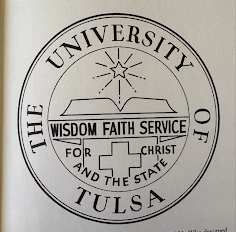
Today, relics of a past religiosity can be found strewn across our website, our buildings, and our traditions. Our motto remains “Wisdom, Faith, Service,” and these words appear on the university’s seal, although the name of our Lord no longer does—it is unclear when this change occurred. It seems that this motto remains more as a tribute to our history than as the true guiding principle of our work and studies, since it seems that Faith, who once held a place of honor here, is now threatened with being cast out entirely. Of course, most Christians would contend that it is not possible to eradicate faith from the human heart, and so neither from our institutions. The question may not be whether we have faith, but where we put it: if our university seems to have lost faith in Christ, something has taken his place.
The diagnosis Clarke gave a century ago feels shockingly modern, although it may have to be slightly amended to fit our current era. When he wrote that the college is under immense pressure “to succeed, whether or not Christian ideals were sacrificed,” we can imagine him implicating not only our athletics, but our academics, our internships, our extracurriculars, and our career preparations, and we can know that his reprimand can apply to any of us as much as it applies to the university as a collective unit, or to our administration. Academic excellence and career readiness are of course worthy pursuits, but they are no substitute for the education of the soul. It is easy to decry the secularization of our institutions and it is much more difficult to examine ourselves and understand where we may have erred in making idols of measures of worldly success. If we are to have any hope of Christ reclaiming his seat in board meetings and lecture halls, we must first allow him to take his throne in our hearts.
We can mourn the loss of our university’s Christian identity and even gently criticize those in power who have done little to preserve it, but we must recognize that secularism at TU has been chronic and progressive—it is not a novel invention of the 21st century. But what began as a mission school can become mission ground again. Those of us who share faith in Christ would do well to honor our school’s Christian heritage, to allow ourselves to be guided by the tenets of wisdom, faith, and service, and to carry with us to all of our classes and through all of our lives the belief which inspired our founders that the gospel demands to be shared.
References
“Campus Ministries.” The University of Tulsa, 21 Aug. 2025, https://utulsa.edu/about/facilities/sharp-chapel/campus-ministries/.
“Covenant Partners.” Synod of the Sun, https://www.synodsun.org/covenant-partners. Accessed 14 Jan. 2026.
Covenant Partners | Synod of the Sun. 21 June 2021, https://web.archive.org/web/20210621162724/https://www.synodsun.org/covenant-partners.
Covenant Partners | Synod of the Sun. 7 Dec. 2021, https://web.archive.org/web/20211207030802/https://www.synodsun.org/covenant-partners.
“History and Traditions.” The University of Tulsa, https://utulsa.edu/about/why-tu/history-traditions/. Accessed 14 Jan. 2026.
Logsdon, Guy William. The University of Tulsa. Oklahoma Press, 1977. Oklahoma Horizons.
“Presbyterian Connection.” The University of Tulsa, https://utulsa.edu/about/facilities/sharp-chapel/presbyterian-connection/. Accessed 14 Jan. 2026.
Weinberg, Justin. Philosophy Threatened at the University of Tulsa (Updated) - Daily Nous. 12 Apr. 2019, https://dailynous.com/2019/04/12/philosophy-threatened-university-tulsa/.